There's a folder on your desktop called "memoir."
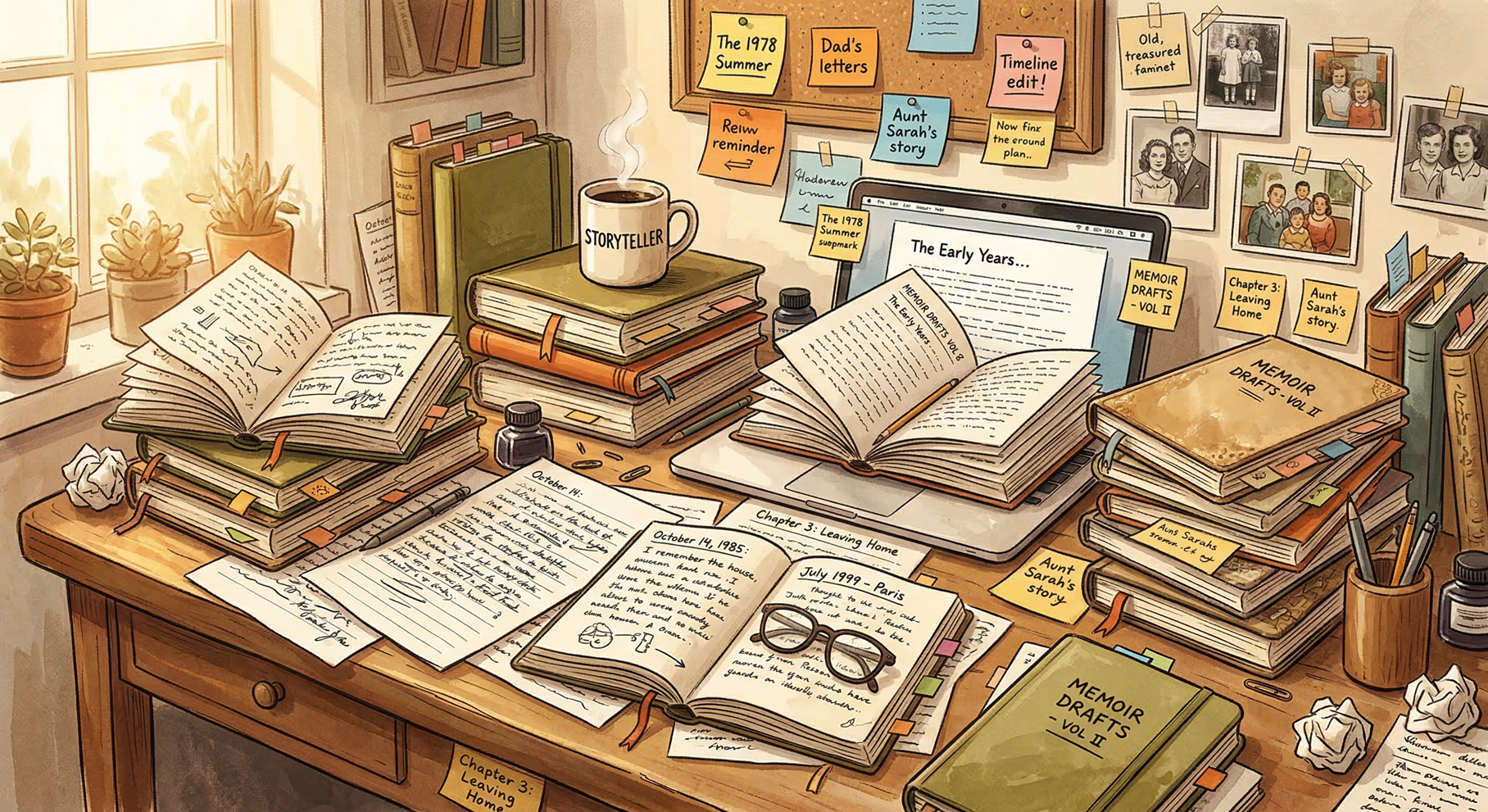
You haven't opened it in six months. Maybe longer. You know what's in it. Bits and pieces. A story about your father you wrote the week after he died. Three pages about the year everything went sideways. A list of memories you jotted down one Saturday morning when the coffee was good and the phone wasn't ringing.
There are more pieces somewhere else. Notes on your phone. An email you sent yourself at 2 AM because you were afraid you'd forget the details by morning. A journal entry from a trip that changed you. Half a chapter in a Word document that doesn't connect to anything.
You've been meaning to turn all of it into a memoir. For years. Maybe decades.
But every time you sit down to start, the same thing happens. The pile feels too big. You don't know which story goes first. You open a blank page, stare at it for twenty minutes, and close it again without writing a word.
And the longer you don't start, the heavier it gets.
You tell yourself the problem is time. But if you're honest? The problem is that you don't know what to do when you open that folder. You don't know which pieces belong together. You don't know whether the stories add up to one book or three books or no book at all. And you definitely don't know where to begin.
So you close the laptop. Not because you don't want to write. Because every time you try to figure out where to start, you loop back to the same paralysis. And eventually, "figuring out where to start" becomes its own kind of procrastination.
At 3 AM, the thought creeps in: Maybe I'm just not the kind of person who finishes things like this.
That's not true.
But it feels true when your scattered materials have no place to land.
"I have hundreds of essays, journals, and poems scattered everywhere."
"I got to over 100 scenes in a table in Word and gave up."
"Memoir became an unfinished project I've all but abandoned, not out of disinterest, but out of overwhelm."
"I have snippets in my phone, in emails to myself, on Scrivener and Word. I have several filing systems that don't always make sense a few months after I created them."
"How do you make a narrative out of a life?"
"I get confused and stop."
Sound familiar?
Here's the thing nobody talks about: you don't have a writing problem. You have an organization problem.
You don't need more inspiration. You don't need to become a "better writer." You don't need a six-month workshop where strangers critique your most personal stories.
You need a system. A clear, step-by-step method for taking the beautiful, tangled chaos in your head and turning it into a book with chapters, scenes, and a story that holds together.
That's exactly what the LIFE Chapters Method is.
You have already done the hard part. You've lived the story. What comes next is the organizing, and that's a solvable problem. — Joseph Michael
Most memoir programs start with writing. They assume you know what your book is about. But that's not where you're stuck. Is it?
You're stuck before the writing. You're stuck in the gap between "I have all these memories" and "I have a book." That gap is where memoirs go to die.
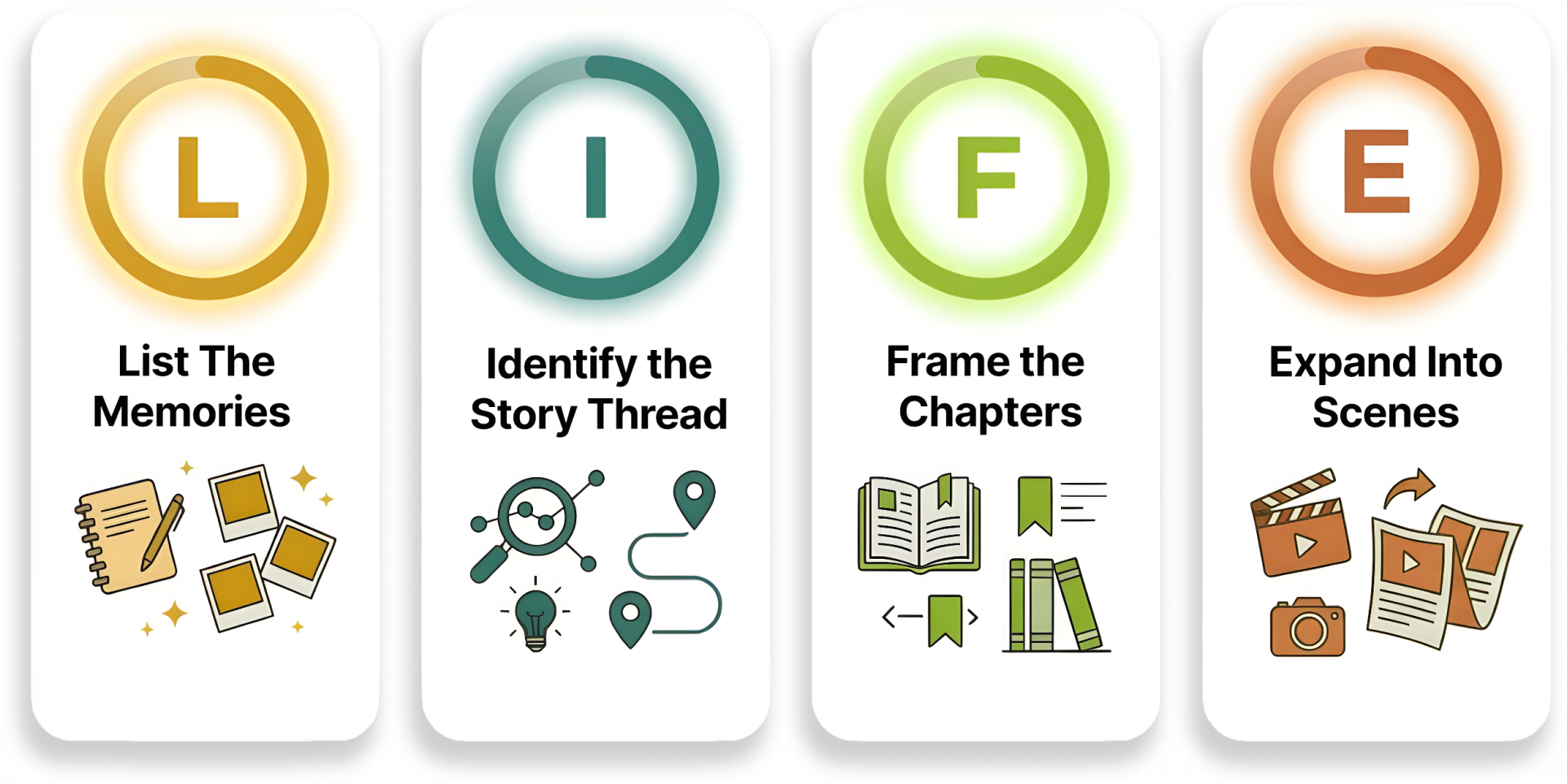
The LIFE Chapters Method lives in that gap. Four steps. Each one solves a specific problem that's been keeping you frozen.
The problem it solves: You sit down to start your memoir and your brain goes blank. Or worse, it goes everywhere at once. Sixty, seventy, eighty years of experiences flooding in with no order, no priority, and no entry point.
What happens: You stop trying to write and start remembering. Nine trigger categories (Firsts, Turning Points, Relationships, Places, Sensory Snapshots, and more) pull memories out of you that you forgot you had. This isn't journaling. It's targeted memory retrieval. Most people have 30, 40, 50 memories on the page in a single sitting.
The problem it solves: You have the stories but they feel like a collection of episodes, not a book. You've heard the phrase "through-line" but when you try to find yours, all you see is contradiction. What is this memoir actually about?
What happens: Three guiding questions, applied to your Memory List, surface the theme that was already there. You didn't invent your through-line. You reveal it.
The three questions: What keeps showing up across your memories? What changed you most? What would you tell your grandchild if you only had one story to give them?
The problem it solves: You have the memories and the through-line, but you still can't see the book. You've tried timelines that turned into encyclopedias. You need to see the whole thing, at once, in a way that makes visual sense.
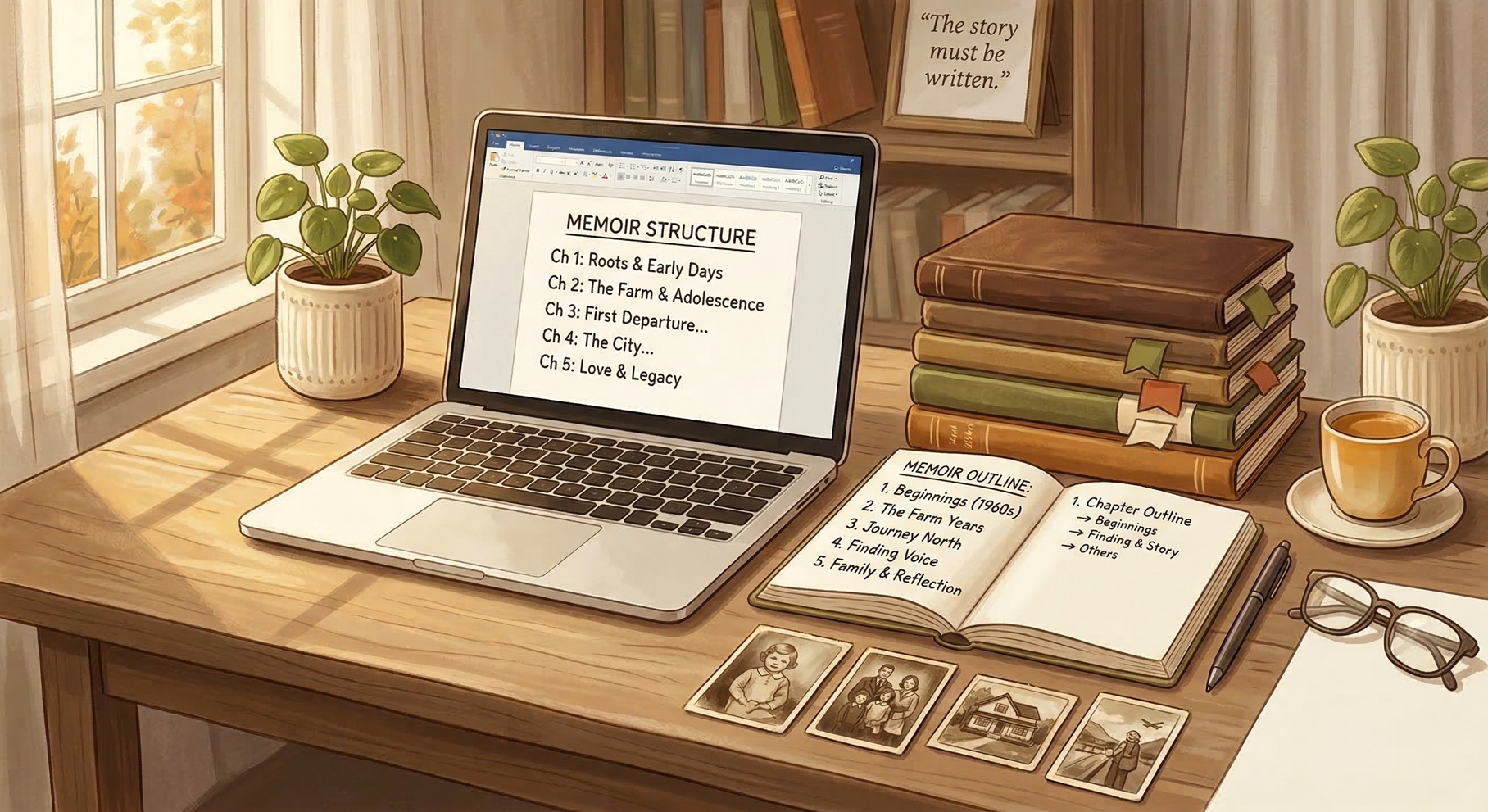
What happens: You learn three simple chapter structures (Timeline, Theme Chapters, and Turning Points), choose the one that fits your story, and sort your memories into chapters. This is the moment people describe as the lightbulb.
The problem it solves: You know what happened. But when you try to write it, it comes out sounding like a report. You've heard "show don't tell" a hundred times but nobody ever explained how to actually do it.
What happens: You learn the Scene Formula: Place + People + Conflict + Reflection. Four elements. That's "show don't tell" made concrete and repeatable. And the Kitchen Table Rule makes it feel natural: write each scene as if you're telling it to someone you love, sitting across from you at the kitchen table.
Before I built this, I spent months talking to memoir writers. Not surveys. Not multiple choice. Real conversations. Hundreds of them.
You know what almost nobody said? "I need to become a better writer."
What they said was: I don't know where to start. I have too much material. I can't find the thread. I don't know what to leave out. I feel overwhelmed every time I open the document.
Those aren't writing problems. Those are architecture problems. And architecture problems have solutions.
Most memoir programs teach you craft. How to write better sentences. How to develop your voice. How to workshop scenes in a group of strangers.
That's fine if your problem is craft. But if your problem is that you have decades of material and no idea how to turn it into a book? Craft instruction doesn't solve that. It just gives you prettier fragments.
The LIFE Chapters Method solves the organization problem first. Because once you have the architecture, the writing becomes the easy part.
And here's something that surprised even me: I heard from published, award-winning authors who said memoir organization was "an overwhelming task." Experienced novelists who found the blank screen "more intimidating than ever" when it came to their own life story.
If published authors struggle with this, it's not about talent. It's about having the right system.
Three live sessions. Three sets of deliverables. You'll leave each week with something real and tangible, not just notes.
We start by tackling the #1 thing that keeps memoir writers frozen: where to begin. You'll learn why memoir isn't autobiography (and why that's freeing), then dive into the Memory Dump exercise using nine trigger categories that pull stories out of you that you forgot you had.
Now that you have your memories and your through-line, it's time to see your book. You'll learn three simple chapter structures and choose the one that fits your story.
Your book has a blueprint. Now it's time to write it. You'll learn the Scene Formula and the Kitchen Table Rule: write each scene as if you're telling it to someone you love.
I've spent the last decade helping writers tackle overwhelming projects, one step at a time. My courses have helped over 100,000 writers get organized, get unstuck, and actually finish what they started.
I'm not a memoir expert. I'll tell you that upfront. What I am is a systems teacher. I take complex, overwhelming projects and break them into simple, clear steps that anyone can follow. That's what I've done for over 100,000 writers with Scrivener, and it's exactly what I've done with memoir.
The LIFE Chapters Method wasn't invented from theory. It was built from hundreds of real conversations with memoir writers who told me exactly what wasn't working and what they needed instead. You're the reason this course exists.
These aren't afterthoughts. Every bonus below was built to solve a specific problem that real memoir writers told me about. When you register, you get instant access to the members area where your bonuses, replays, and resources live.
The memory-triggering resource that does the work your brain can't do alone.
300 carefully crafted questions organized into 9 categories, each designed to open a door you didn't know was closed. Not generic journal prompts. Specific, personal, surprising questions that pull stories out of you.
Format: Beautifully Designed PDF — Available Day 1
Six decision flowcharts that solve the most paralyzing question in memoir writing: what stays and what goes.
When you've got decades of material, the question isn't "What do I write about?" It's "What do I leave out?" These six printable flowcharts walk you through simple yes/no decisions and give you a clear answer every time.
Format: 6 Printable Flowcharts + Worksheet — Available Day 1
The bridge between your most trusted tool and your most important project.
A step-by-step video tutorial showing you exactly how to set up a Scrivener project specifically for your memoir, from the creator of Learn Scrivener Fast.
Format: Video Tutorial + PDF Cheat Sheet + Template — Available Day 1
Your private writing partner that never judges, never gets tired, and knows exactly what to ask.
Format: Video Tutorial + Prompt Template PDF
Because the hardest part of your memoir isn't the writing. It's deciding what you're brave enough to say.
Format: Written Guide (PDF) + Printable Permission Slip
The productivity framework that turns your chapter outline into a finished first draft.
One chapter per month. Each writing session is 45-90 minutes. A 10-chapter memoir takes 10 months. If you miss a week? The system doesn't break.
Format: Written Guide + Printable Monthly Planner
Because some of the best memoir writers aren't writers at all. They're storytellers.
Format: Video Tutorial + Quick Start Guide
The short list of tools I actually use and recommend. No fluff. No affiliate hype.
Format: PDF Reference Guide
These aren't afterthoughts. They're tools I built specifically to support each step of the LIFE method. Some of these resources are worth the price of admission on their own. — Joseph Michael
I want to say something gently, because it matters.
One of the writers who responded to my email named the thing nobody wants to name. He said his biggest holdback was "assuming I'll live forever."
You can smile at that. And then you can sit with it for a second.
That's why the memoir keeps getting pushed down the list. Not because it's not important. Because on some level, it's always felt like there would be more time. Next year. After the house gets organized. After the grandkids settle down.
But another writer, in her 80s, said gently and without melodrama that she "won't be around forever." And someone else told me she wanted to "get those memories out before it's too late."
Those aren't people being dramatic. Those are people doing honest math.
Here's the quieter cost that nobody says out loud: for every year you don't organize your material, the specific details that make memories come alive get a little hazier. The exact words your mother used. The precise way the kitchen smelled that Christmas morning. The expression on his face when he said the thing that changed everything.
Those details aren't getting sharper with time.
"Someday" is not a date on the calendar. This Wednesday at 4pm is.
Because you're part of this community and you're seeing this before the public launch, you're getting first access at our deepest discount.
Regular Price: $197
You're saving $130
Only available at this price during this launch
Instant access to the members area and your bonuses the moment you register.
Journals, Word docs, phone notes, memories in your head. You have more material than you know what to do with, and that's exactly the problem.
Not because you don't care. Because every time you try, the pile feels too big and you don't know which piece goes first.
Your grandchildren. Your children. The people who will someday wonder where they came from and who you were.
You don't need an MFA or a publishing deal. You need a finished memoir on a shelf where the people who matter most can find it.
Maybe you took an expensive workshop that focused on craft, not organization. Maybe you tried StoryWorth and it felt incomplete.
You don't need more inspiration. You need someone to say: "Here's step one. Now here's step two." That's what this is.
Full replays will be available in the members area within 24 hours of each session. You'll have lifetime access. That said, I'd encourage you to attend live if you can. The energy, the Q&A, and the accountability of showing up make a real difference.
Not at all. The LIFE Chapters Method works with any writing tool: Word, Google Docs, even pen and paper. The Scrivener bonus is exactly that, a bonus. If you use Scrivener, it'll supercharge the experience. If you don't, the method is just as powerful.
This isn't a writing course. It's an organization system. If you can tell a story to a friend across a kitchen table, you have every skill this method requires. One of the writers who inspired this course said he wasn't interested in becoming an author, just interested in telling his story to his grandchildren. That's exactly who this is for.
Yes. The "Writing Difficult Material: A Permission Slip" bonus was built specifically for this. Many of the writers I talked to flagged emotional difficulty as a real barrier. We address it head-on with a compassionate framework for deciding how much to share, how to protect yourself, and how to handle the living people question.
Most memoir programs focus on craft: better sentences, peer critiques, literary techniques. The LIFE Chapters Method focuses on the problem those programs ignore: organization. You don't need to workshop your most personal stories with strangers. You need a system that turns scattered material into a book. At $67, it's a fraction of what most workshops charge, and it gives you something they don't: a clear, step-by-step structure you can follow from start to finish.
Yes. The LIFE framework adapts beautifully to biography, family history, and writing about a loved one's life. The four steps still apply. The source material just shifts from personal memories to family interviews, diaries, letters, and research.
Two reasons. First, you're part of my community, and you're seeing this before it goes public. This is a genuine thank-you price for the people who've been with me. Second, this is the inaugural live cohort. After these three sessions, the LIFE Chapters Method will become a polished on-demand course at its regular price of $197. You're getting in at the lowest price this will ever be offered.
It's never too late. I heard from a 90-year-old woman who wrote individual life-story books for each of her three sons. Decades later, they told her, "You gave me my life back." Another writer is 86 and working on his second memoir. Your story doesn't have an expiration date. But the sharpest version of your memoir is the one you begin while the details are still vivid.
That's not a problem. That's actually the ideal starting position. The LIFE method is designed to take an overwhelming amount of material and give it shape. The Keep It or Park It Decision Kit specifically addresses this: six flowcharts for deciding what stays, what gets set aside, and whether you have one book or two. Nothing is lost. Everything is organized.
It's a Tuesday morning, six months from now. You're sitting at your desk or your kitchen table with the good light. It's quiet. Nobody needs anything from you yet. The coffee is still hot.
You open your manuscript. Not with dread. With something that feels almost like excitement.
You know exactly where you are. Which chapter you're working on. Which scenes are waiting. What you need to write today. The pile is gone. In its place is a structure you built, chapter by chapter, with your own stories slotted into the right places.
You read back the chapter about the summer you were twenty-three, the summer that changed everything. Reading it now, you feel something specific. Not pride, exactly. Satisfaction. The quiet satisfaction of a thing done. A thing you always meant to do and did.
That's not a fantasy. That's the destination of a four-step process that begins with a memory list you can build in forty minutes.
P.S. If something on this page made you think, "This is what I've been looking for," trust that instinct. It's been right before.
The LIFE Chapters Method was built by listening to hundreds of writers just like you. If your struggle sounds like anything you read on this page, this is the answer. And at $67 (before it goes to $197), the window to get in at this price won't come around again.
P.P.S. Remember: you get instant access to the members area and your bonuses the moment you register. That means the 300 Questions resource, the Keep It or Park It flowcharts, and the Scrivener tutorial are waiting for you before Session 1 even begins. You could start building your Memory List today.
Cheering for you 👏
— Joseph Michael